


Asakusa & Tokyo Skytree Wedding Photos | Traditional Japan Meets Modern Tokyo in One Day
Why Shoot at Both Asakusa and Tokyo Skytree?
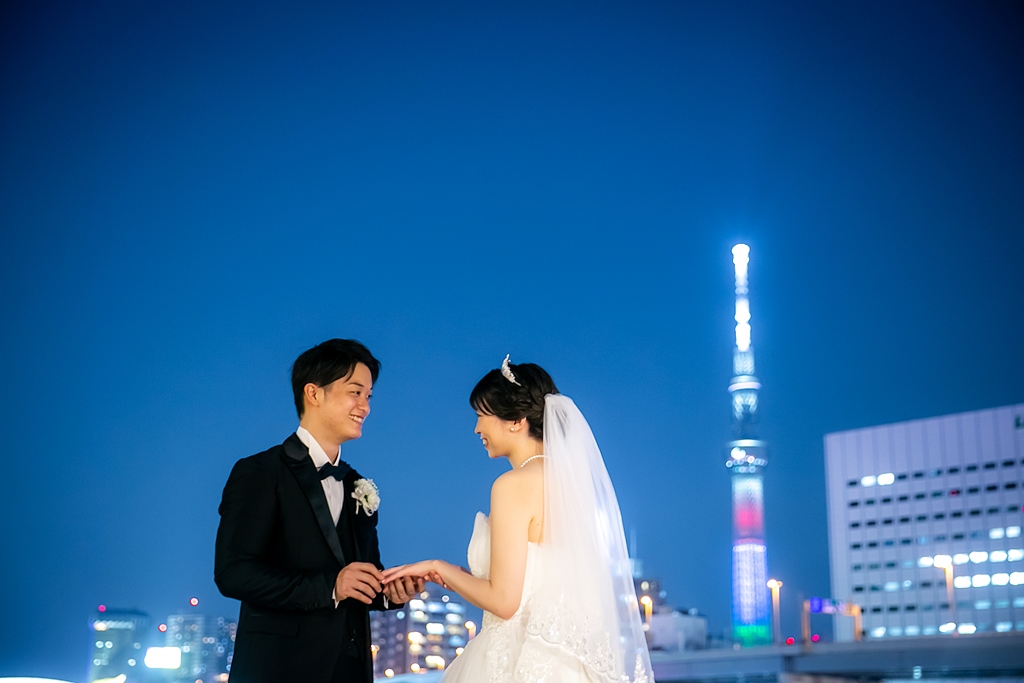
Tokyo contains multitudes. It is simultaneously one of the world’s most ancient continuously inhabited cities and one of its most aggressively modern. Nowhere is this duality more concentrated — or more visually legible — than in the pairing of Asakusa and Tokyo Skytree.
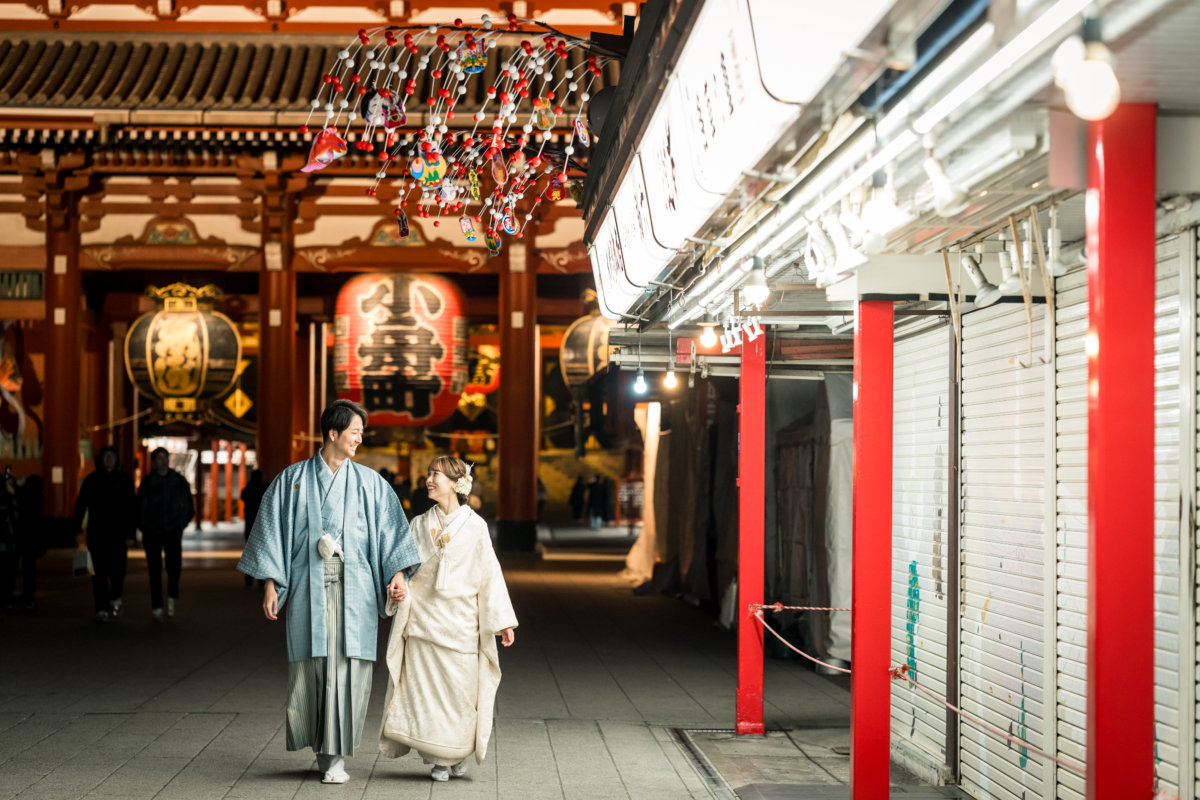
Asakusa has been Tokyo’s entertainment and spiritual center since the Edo period. Its great Kaminarimon gate — the Thunder Gate, with its enormous red lantern — has stood as a symbol of the city for centuries. The Nakamise shopping street leading to Senso-ji temple preserves an atmosphere of traditional merchant culture that the surrounding city has long since lost. The five-story pagoda, the temple precincts, the back lanes with their weathered signs and narrow passages — this is the Tokyo of woodblock prints and historical drama, surviving in the present.
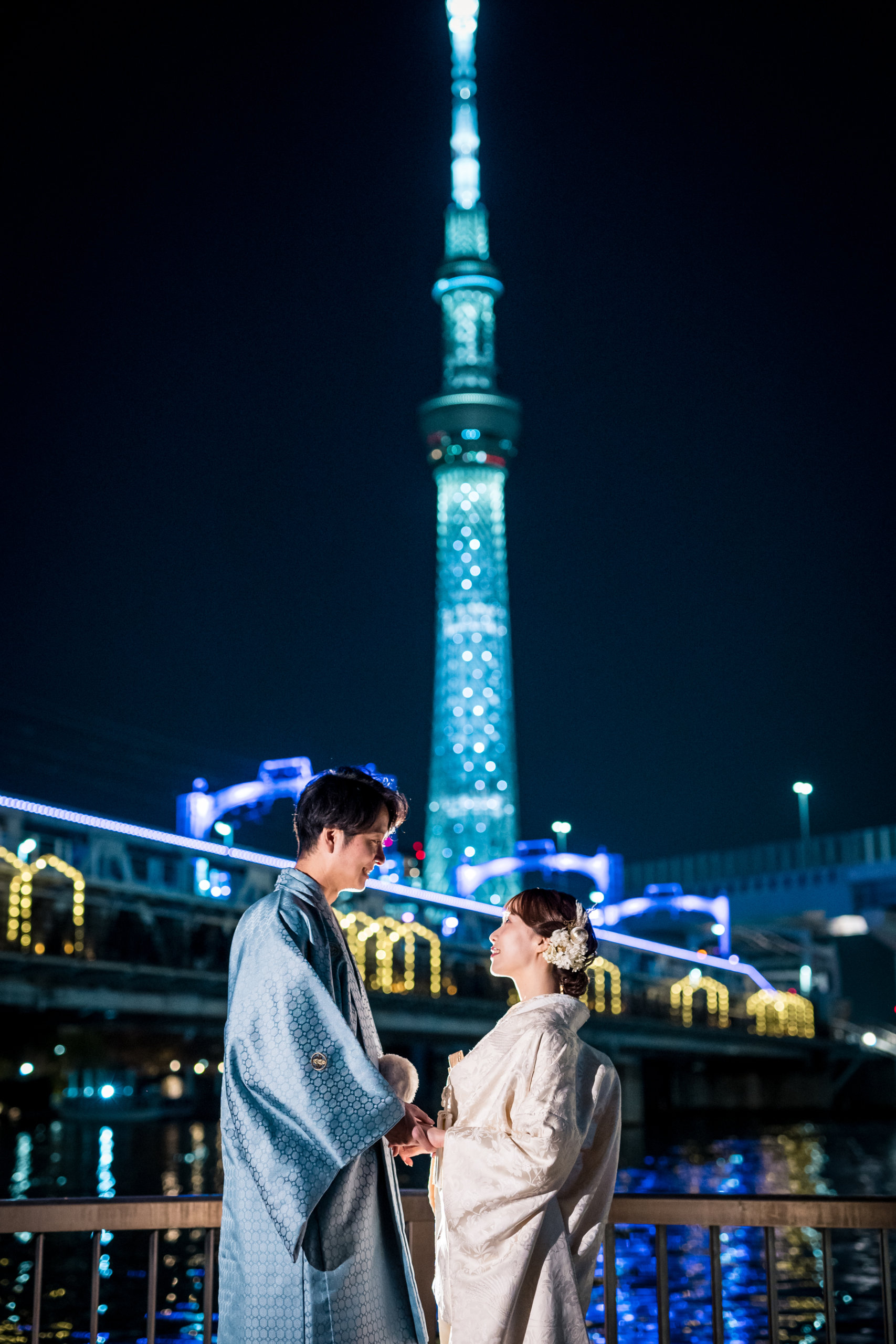
Tokyo Skytree, rising 634 meters from the eastern bank of the Sumida River, represents a completely different Tokyo — one of extreme engineering ambition and contemporary urban confidence. From the river banks below, the tower fills the sky. Its reflection in the water creates images of almost unreal symmetry. At dusk, when the structure is illuminated and the sky shifts through its sunset palette, the riverside becomes one of the most dramatically photogenic locations in Japan.
Photographing both locations in a single day — moving from the ancient district of Asakusa to the foot of the Skytree, crossing the Sumida River between worlds — produces a wedding album unlike any other. The story it tells is specifically, irreducibly Tokyo’s: a city that has never stopped being itself, even as it has continuously reinvented what that means. For international couples visiting Japan and wanting photographs that capture what Tokyo truly is, this combination is unmatched.
No photography permits are required at either location. This is among the most accessible major wedding photography destinations in the city.
Asakusa Shooting Spot Guide
Asakusa contains more photographic environments per square kilometer than almost anywhere else in Tokyo. Here is what each major location offers.
🏭 ① Kaminarimon Gate (Thunder Gate)
The gate’s great red lantern — bearing the characters for “Thunder Gate” — is one of the most recognized images in Japan, and for good reason: it photographs exceptionally well. The red of the lantern against white or pale kimono creates a color pairing of great force. Shot from front-center with the couple small against the full gate, the composition conveys both the gate’s scale and the couple’s presence within it. Shot from the side with the lantern in background, it creates a more intimate frame. The energy of visitors moving through the gate — the sense of a living, active place — adds a quality of authenticity to images taken here that quieter locations cannot provide.
🏭 ② Nakamise Shopping Street
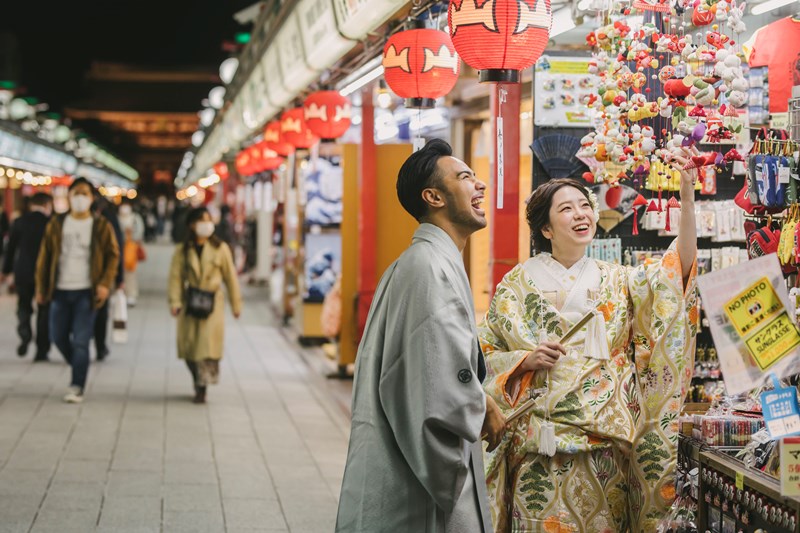
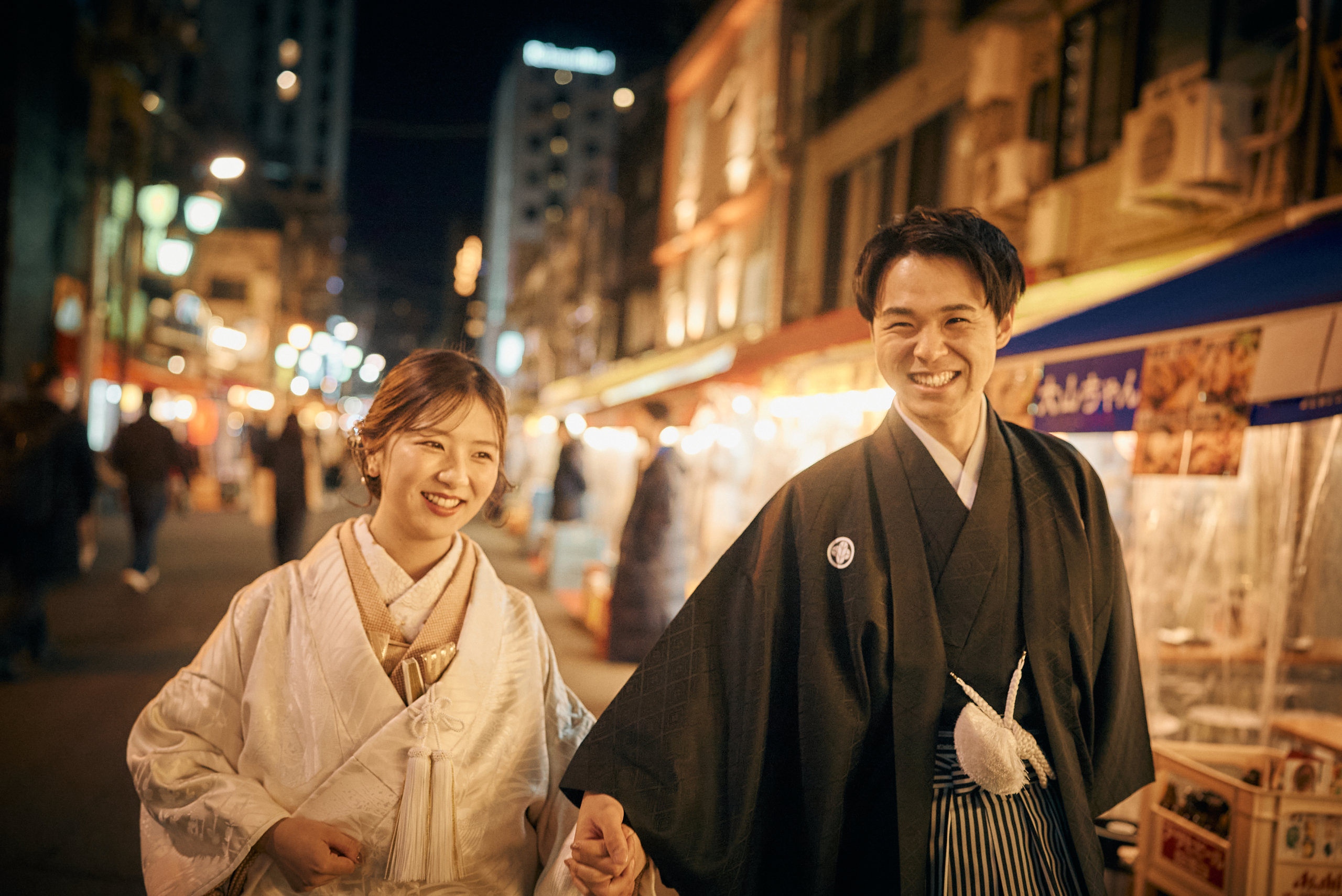
The lantern-lined stone path of Nakamise, receding toward the temple gate in the distance, provides one of Asakusa’s most classic compositional opportunities: the vanishing-point shot, with the couple walking slowly away from the camera as the lanterns converge in the background. This image — a couple in kimono walking the merchant street toward the temple — is deeply traditional in its composition and deeply satisfying in its execution. The activity and color of the street, the shops and their lanterns, the sense of a place that has been doing exactly this for centuries, all contribute to photographs that feel genuinely alive rather than staged.
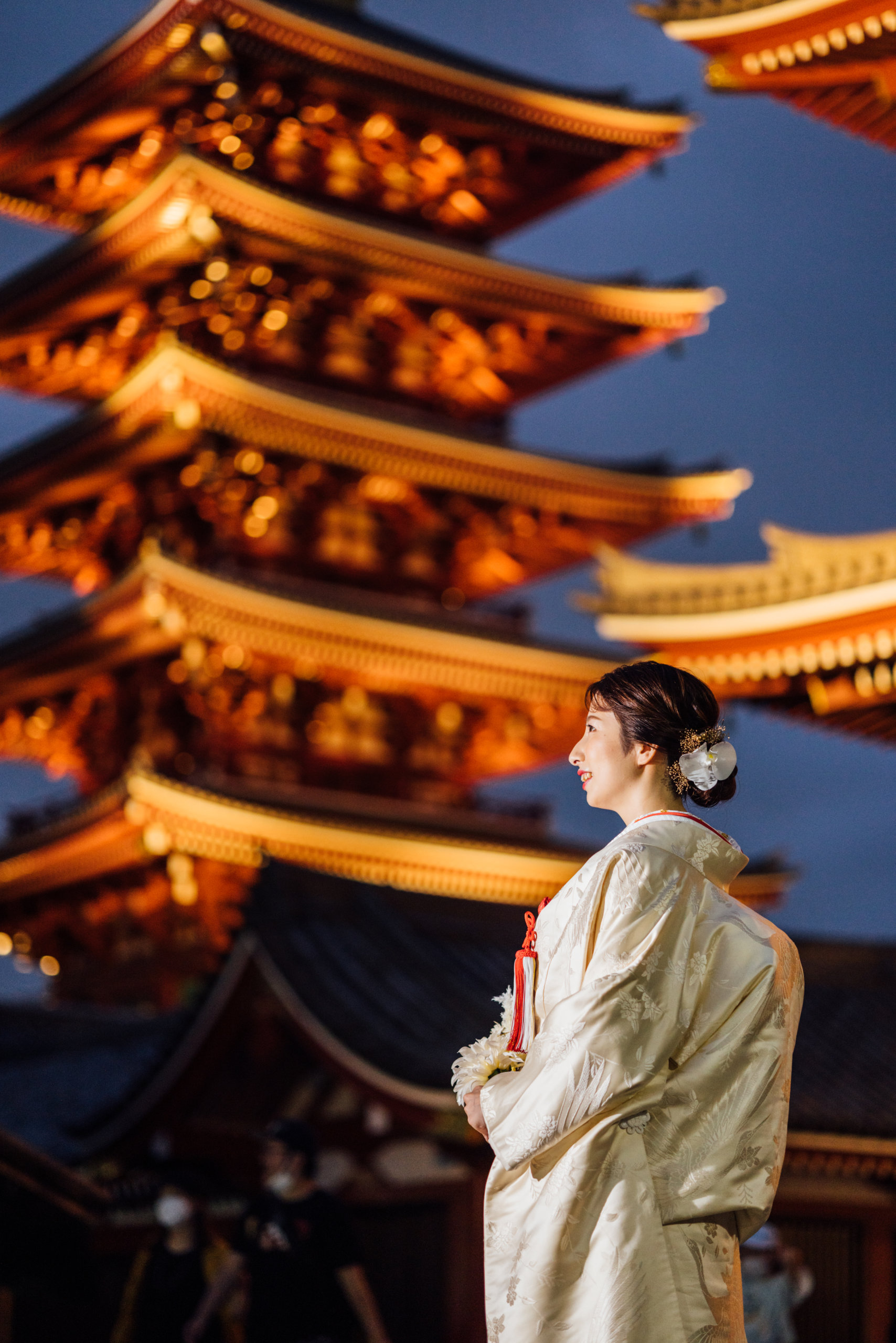
🏭 ③ Senso-ji Temple Precincts & Five-Story Pagoda
Beyond the gate and the shopping street, the temple precincts themselves offer a quieter, more formal environment. The five-story pagoda — one of Tokyo’s most historically significant structures — provides a vertical architectural anchor for wide shots. The main hall’s approach, the incense burner, the fortune slip racks: all of these are Asakusa landmarks that contextualize the couple within Japan’s religious and cultural traditions. The omikuji fortune slip experience, in particular, generates moments of genuine, unscripted emotion that photograph beautifully.
🏭 ④ Back Lanes & Asakusa Streetscapes
The narrow lanes behind the main tourist circuit — traditional signage, old shopfronts, weathered tile roofs — provide an Asakusa that visitors rarely find. In these lanes, the tourist infrastructure disappears and something more authentic remains. The light in these narrower spaces is more directional and dramatic. Kimono against the texture of old wood and worn stone produces images of genuine historical depth that the main streets, for all their spectacle, cannot replicate.
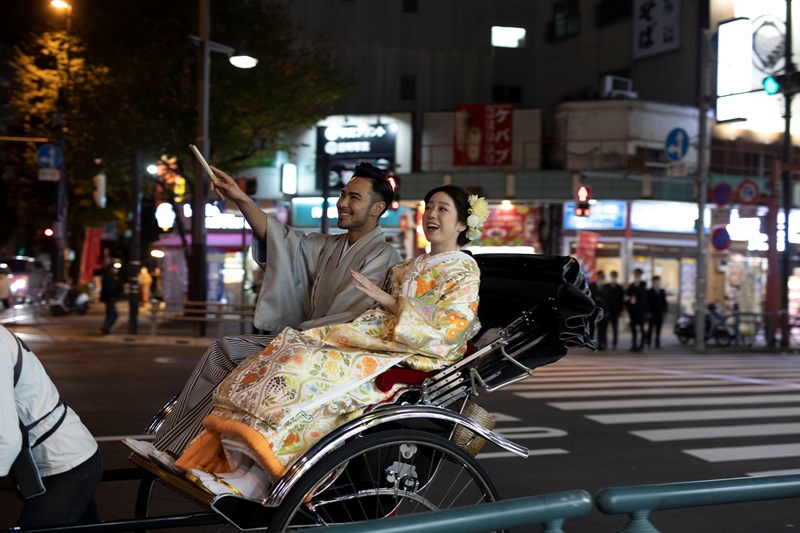
🏭 ⑤ Rickshaw (Jinrikisha)
The traditional rickshaw remains active in Asakusa, and incorporating it into a wedding photography session adds a narrative element that no other location can offer. Being pulled through Nakamise in full kimono — looking out at the lanterns, the shops, the other visitors — is an experience specific to this place and this tradition. The photographs that result carry a quality of lived experience rather than posed recreation. Please inquire with our team regarding rickshaw arrangements.
Tokyo Skytree & Sumida River Shooting Spots
Crossing the Sumida River from Asakusa brings a complete environmental shift. The ancient district gives way to the foot of a structure so large it requires active cognitive adjustment to perceive.
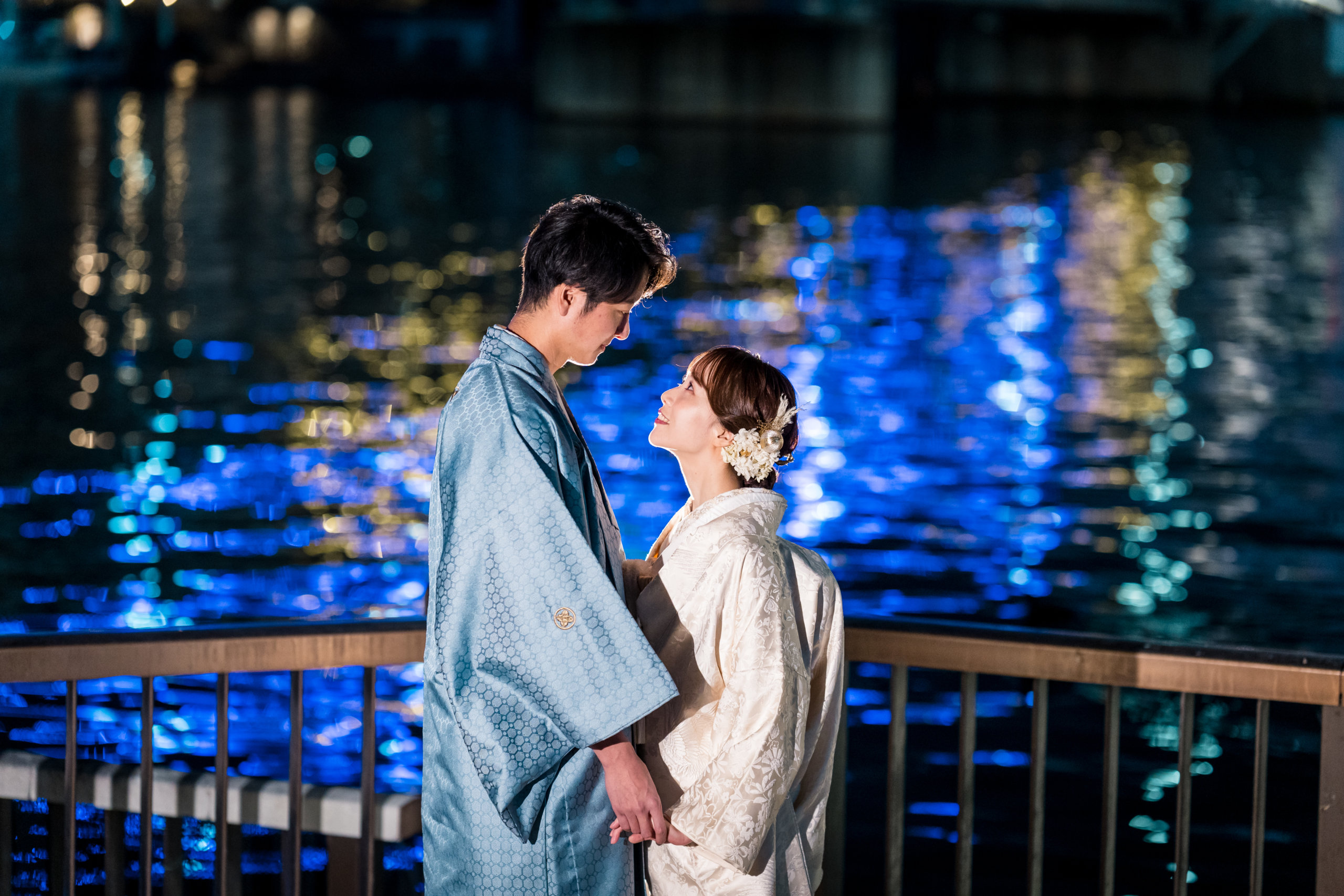
🏭 ① The Sumida Riverbank
The river walk offers the most expansive views of the Skytree — and, when the water is calm, the most striking reflection shots. The tower’s image, perfectly doubled in the surface below, creates a compositional symmetry that makes photographs look enhanced when they haven’t been. A couple in wedding kimono standing at the water’s edge, with this reflection surrounding them, produces one of the most visually distinctive images available in Tokyo wedding photography.
🏭 ② Tokyo Skytree as Backdrop
At closer range, the Skytree fills the frame in ways that make the couple seem small — intentionally — against the scale of the structure. Wide shots with the couple in the foreground and the tower occupying most of the sky above create images of genuine contemporary drama. The contrast between traditional kimono and cutting-edge architecture is nowhere more pronounced than here: two aesthetics from entirely different centuries in the same frame, both belonging to the same city.
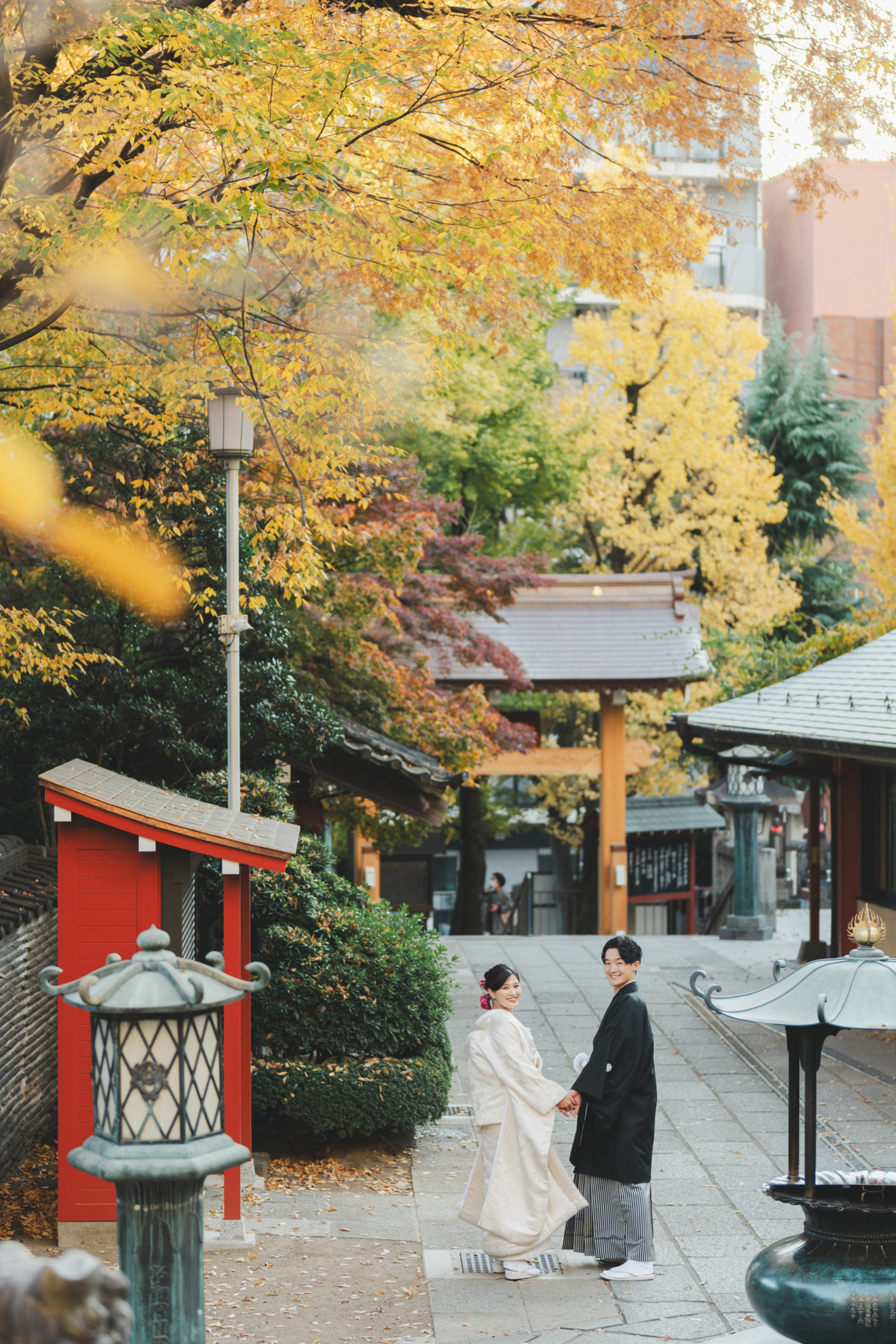
🎓 View Our Kimono Location Photography Plan
Browse our outdoor kimono plan — including what’s included, pricing, and the stunning Tokyo locations available.
Cherry Blossom & Seasonal Highlights
The Asakusa and Skytree area transforms dramatically with the seasons. Each season offers something distinct and worth planning around.
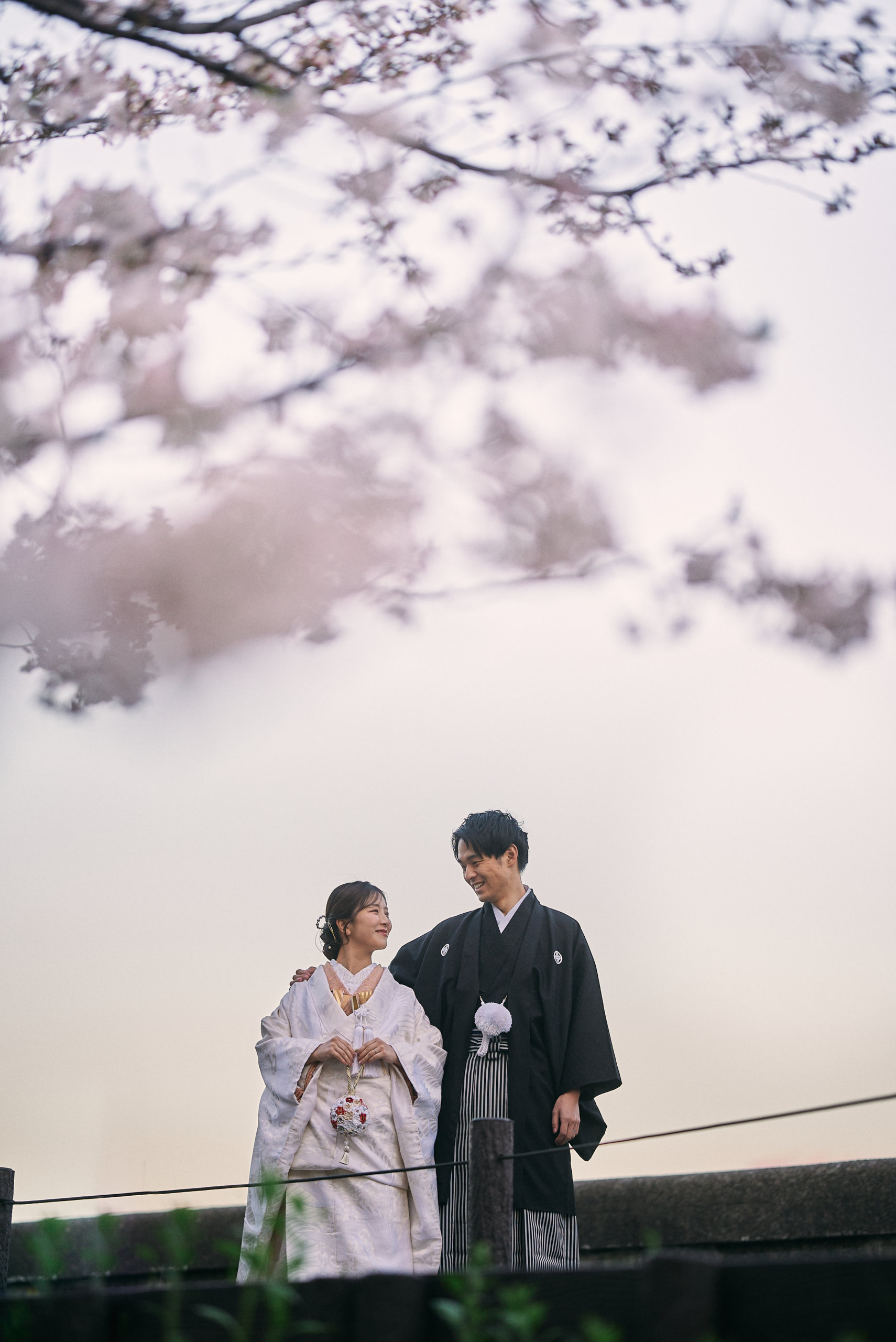
Cherry blossom season (late March to mid-April) is the most requested time for this location, and for good reason. The Sumida River is lined with some of Tokyo’s most celebrated cherry trees — and the combination of full-bloom sakura, the river, and the Skytree in a single frame is available nowhere else in Japan. At Asakusa itself, cherry blossoms softening the edges of the gate and the pagoda create images of Japanese spring that feel pulled from a painting. The season is brief and popular; early booking is essential.
Summer evenings offer a different kind of spectacular. The Sumida River at dusk, with the Skytree beginning its nightly illumination as the sky shifts from blue to orange to deep purple — this is the most dramatically lit version of the Skytree available, and the most photogenic. Summer also brings the energy of Asakusa’s festival culture to the streets, creating a lively and colorful photographic atmosphere in the traditional district.
Autumn brings clear skies and the best visibility for the Skytree — reflection shots are at their sharpest in the crisp autumn air. The seasonal foliage in and around Asakusa adds warm color to the traditional streetscapes. Comfortable temperatures make autumn one of the easiest seasons to wear full kimono for an extended day of shooting.
Winter offers clear air and striking Skytree illumination against dark, cold skies. The Skytree’s winter illumination patterns are particularly dramatic when reflected in the river. Asakusa in winter retains its full energy and character — the festivals and traditions of the new year season make this one of the most culturally vivid times to visit.
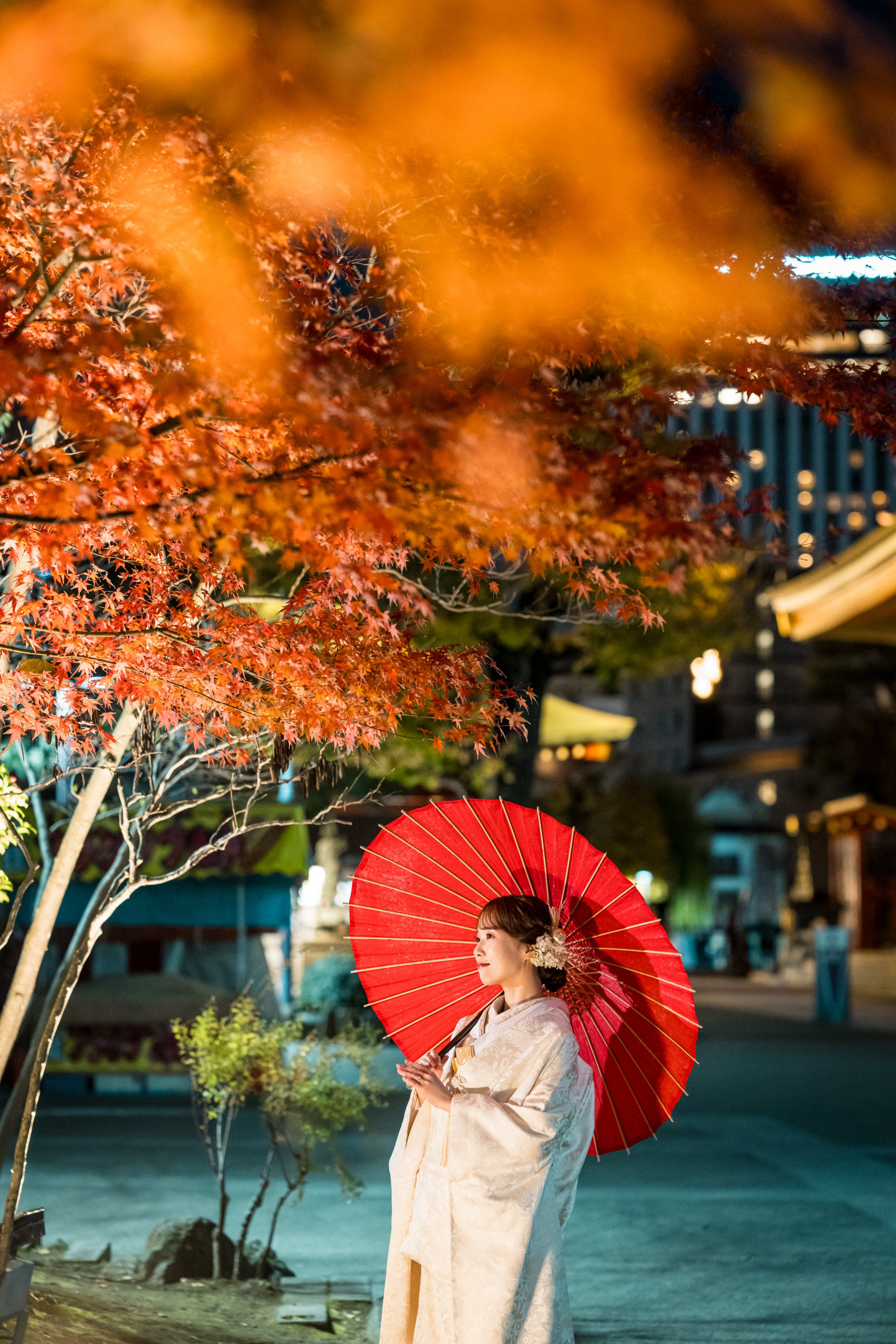
From Our Photographers — What Makes This Location Special
Our photographers have worked this location across all four seasons and in all conditions. Here is what they consistently observe.
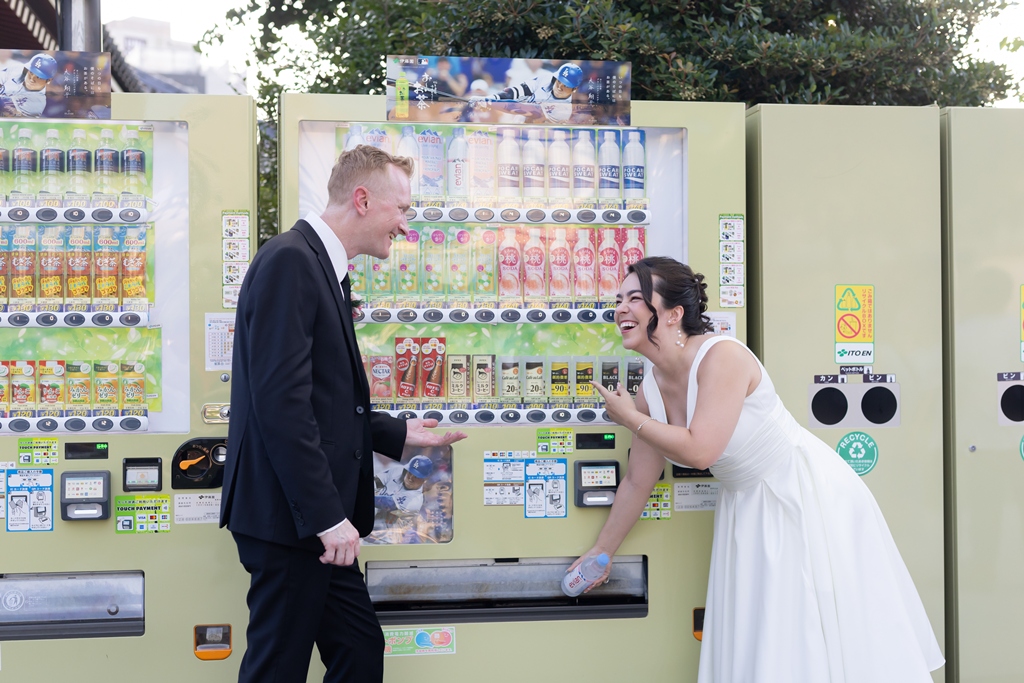
Asakusa & Tokyo Skytree create the perfect Japanese wedding backdrop
If you are looking for an original wedding photo experience that captures the beauty and character of Japan, Asakusa and Tokyo Skytree are the perfect choice. From the iconic Kaminarimon and traditional streets of Asakusa to the breathtaking presence of Tokyo Skytree, this area brings together timeless Japanese culture and the energy of modern Tokyo. We create every Asakusa session to capture this unique contrast, giving you wedding photos that feel unmistakably Japanese and truly your own.
The omikuji moment is always real
We always include the fortune slip experience in Asakusa sessions. The moment of reading the result — whether good or bad — produces facial expressions that no direction can manufacture. International couples, in particular, experience this tradition with a quality of genuine wonder and amusement that shows beautifully in photographs. It is among the most reliably authentic moments in any session here.
The river reflection requires still water
The Skytree reflection shot depends on calm water. Wind disturbs the surface; so do passing boats. We check conditions before building the session plan around this shot, and we schedule the river segment at times when conditions are most likely to cooperate. When it works — and it usually does — the result is one of the most visually striking images we produce at any location. When it doesn’t, we have alternatives. The Skytree photographs well from many angles regardless of water conditions.
The transition between worlds is itself a photograph
Walking across the bridge from Asakusa to the Skytree side — in full kimono, with ancient temple district behind you and the world’s tallest structure ahead — produces a moment that we always shoot. The couple in the middle of the bridge, turning back to look at where they’ve come from, or turning forward to what awaits them: this transitional image, more than any single location shot, captures what it means to spend a day moving through Tokyo’s two most distinct identities.
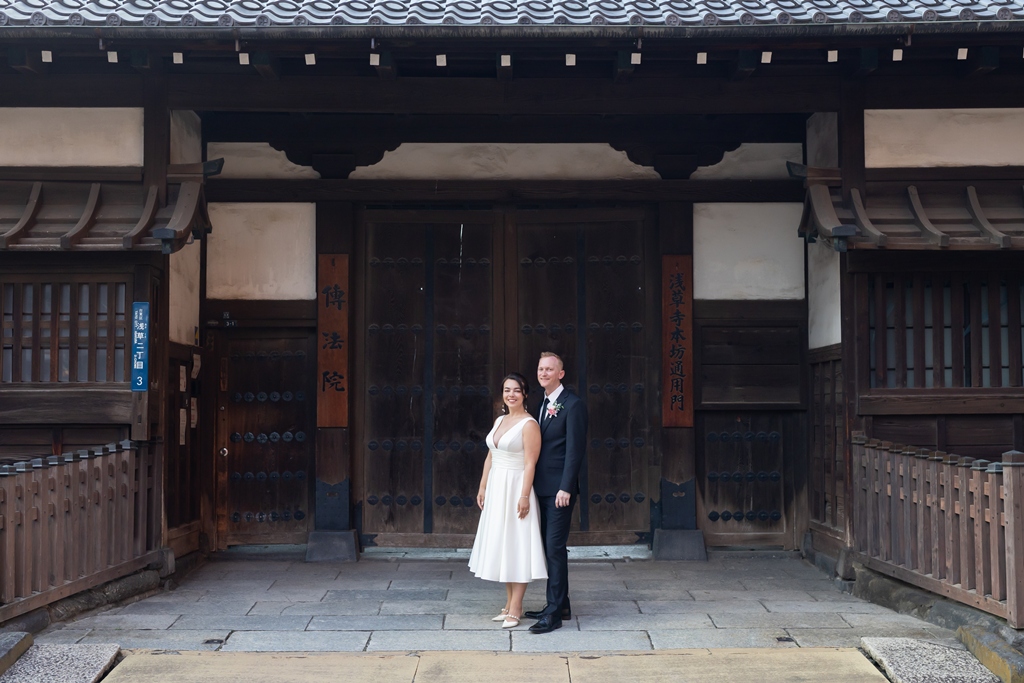
Which Kimono Works Best Here?
The two environments of this double location have very different color palettes and call for different considerations in kimono selection.
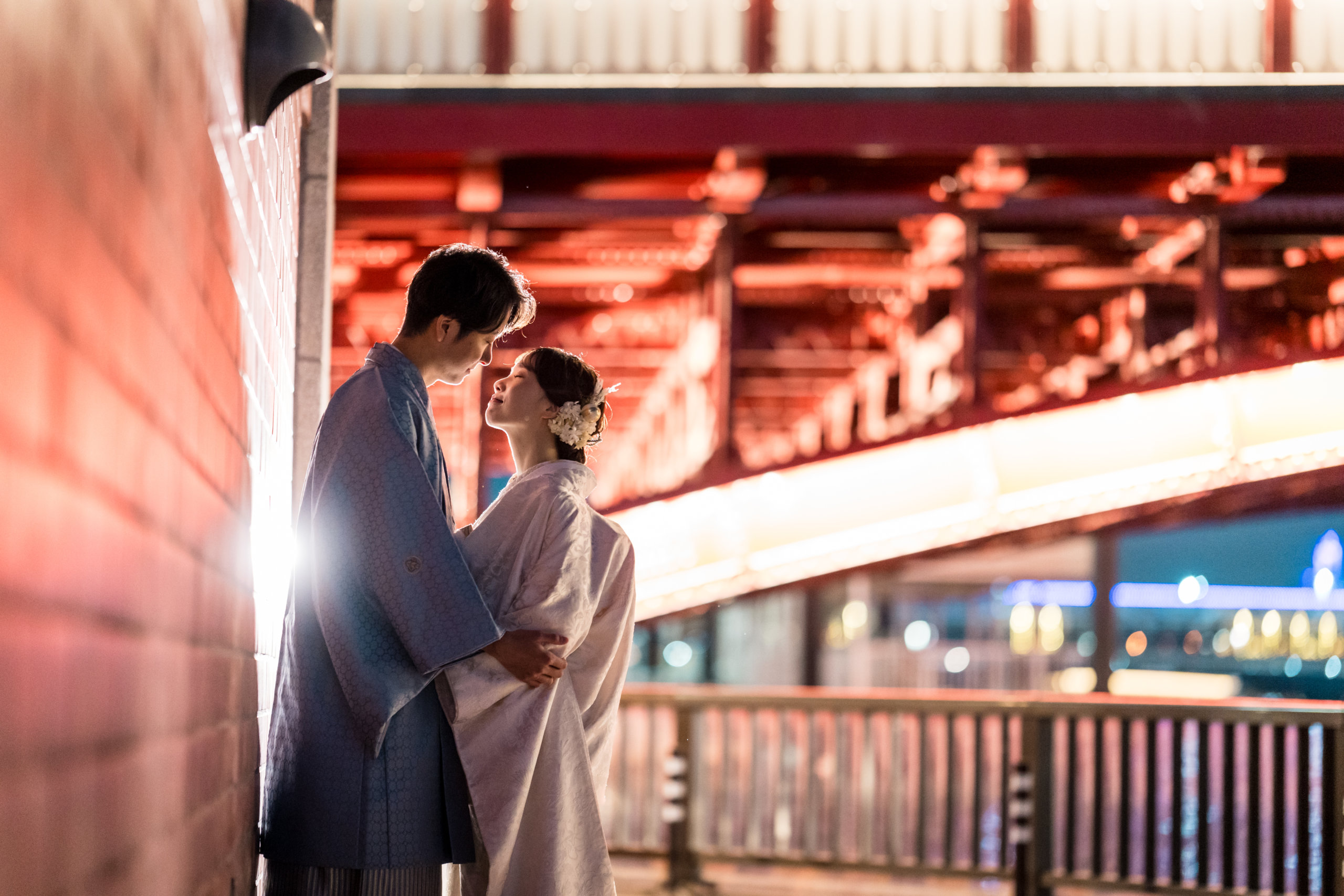
At Kaminarimon and Nakamise, the dominant color is red — the great red lantern, the red of temple architecture, the red and orange tones of the traditional streetscape. White kimono creates the most powerful contrast: pure white against the deep red produces images of striking visual force, and the red-and-white combination is among the most classically Japanese color pairings in existence. Vermilion iro-uchikake harmonizes with the gate’s red, creating a different kind of visual unity — the kimono and the architecture speaking the same color language.
At the Sumida River and Skytree, the dominant colors shift to blue (water, sky) and silver-grey (the tower’s structure). Here, pale blue and indigo-toned kimono harmonize with the environment in ways that feel considered and contemporary. White kimono remains effective — particularly for reflection shots, where the white appears in the water below alongside the tower’s image. At dusk, when the sky shifts to warm tones, warm-colored kimono (vermilion, gold) and the orange sky create a harmonious composition of considerable beauty.
🎓 Kimono by Location — Quick Guide
- Kaminarimon Gate: White for maximum red-white contrast; vermilion for harmony with the gate’s color
- Nakamise & temple precincts: Any color works — the street and architecture are strong enough to ground any kimono
- Sumida River & Skytree (daytime): Pale blue or indigo for harmony with water and sky; white for reflection shots
- River at dusk: Vermilion or warm tones harmonize with the sunset sky; white creates dramatic silhouette
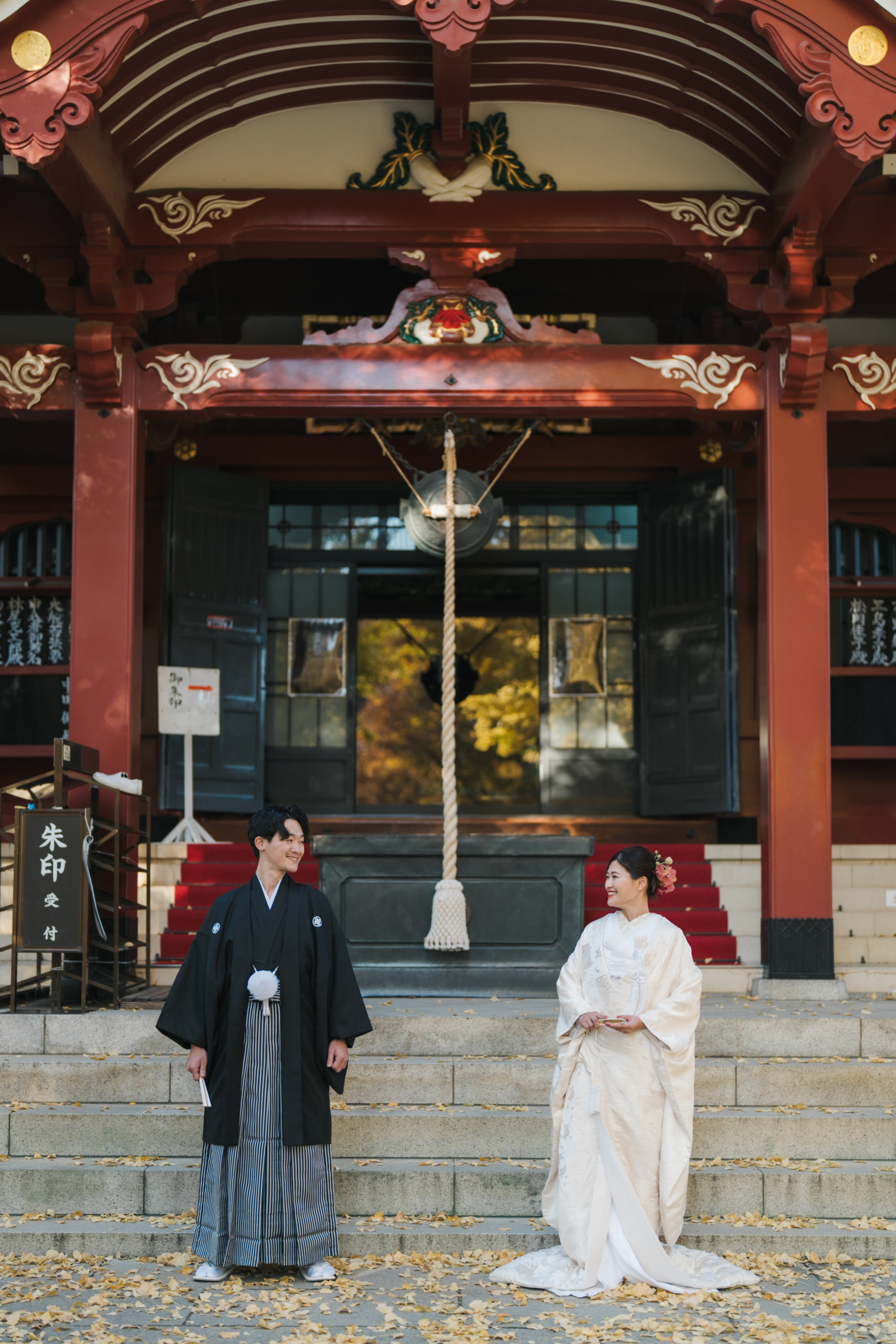
📷 See Real Photos from Asakusa & Skytree
Browse photographs and reviews from couples who have experienced this double location firsthand.
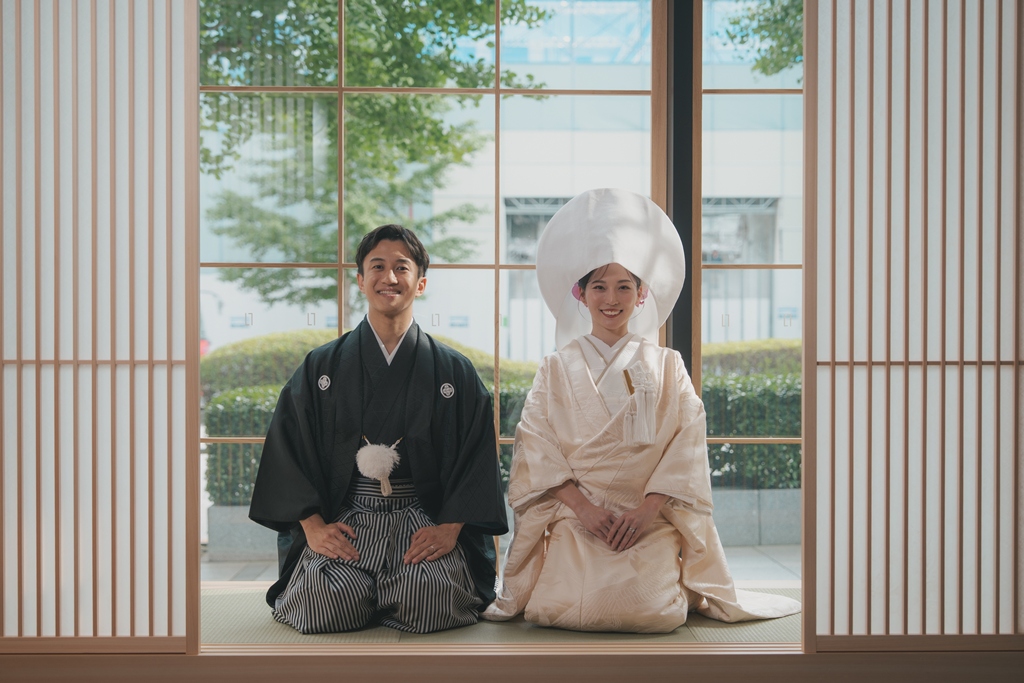
About Wedding Avenue Tokyo Station Studio
Wedding Avenue Tokyo Station Studio is located a 10-minute walk from Tokyo Station’s Yaesu Exit. Asakusa is easily accessible by train, making logistics for this double location session straightforward. All hair, makeup, and kimono dressing takes place at our studio before traveling to Asakusa with our team. English-language support is available throughout the planning and shooting process.
No photography permits are required at either Asakusa or the Tokyo Skytree area. Our standard location photography packages include 200 high-resolution digital images (currently with a 100-image bonus under our active campaign). Date changes for weather are always free. For cherry blossom season sessions, we monitor conditions proactively and suggest schedule adjustments where improved timing is possible.
📋 Summary
- Asakusa and Tokyo Skytree together tell the complete story of Tokyo — ancient and ultramodern, traditional and contemporary, in a single day
- Kaminarimon Gate, Nakamise street, the five-story pagoda, rickshaws, temple precincts, back lanes — Asakusa alone offers extraordinary photographic variety
- The Sumida River reflection shot, with the Skytree doubled in the water, is one of the most visually striking images available in Tokyo wedding photography
- Early morning scheduling is essential for Kaminarimon and Nakamise — and rewarding at the river
- Cherry blossom season, with sakura at both Senso-ji and along the Sumida River, is the most spectacular seasonal moment at this location
- No photography permits required. Wedding Avenue handles everything from kimono dressing to final image delivery, with English support throughout
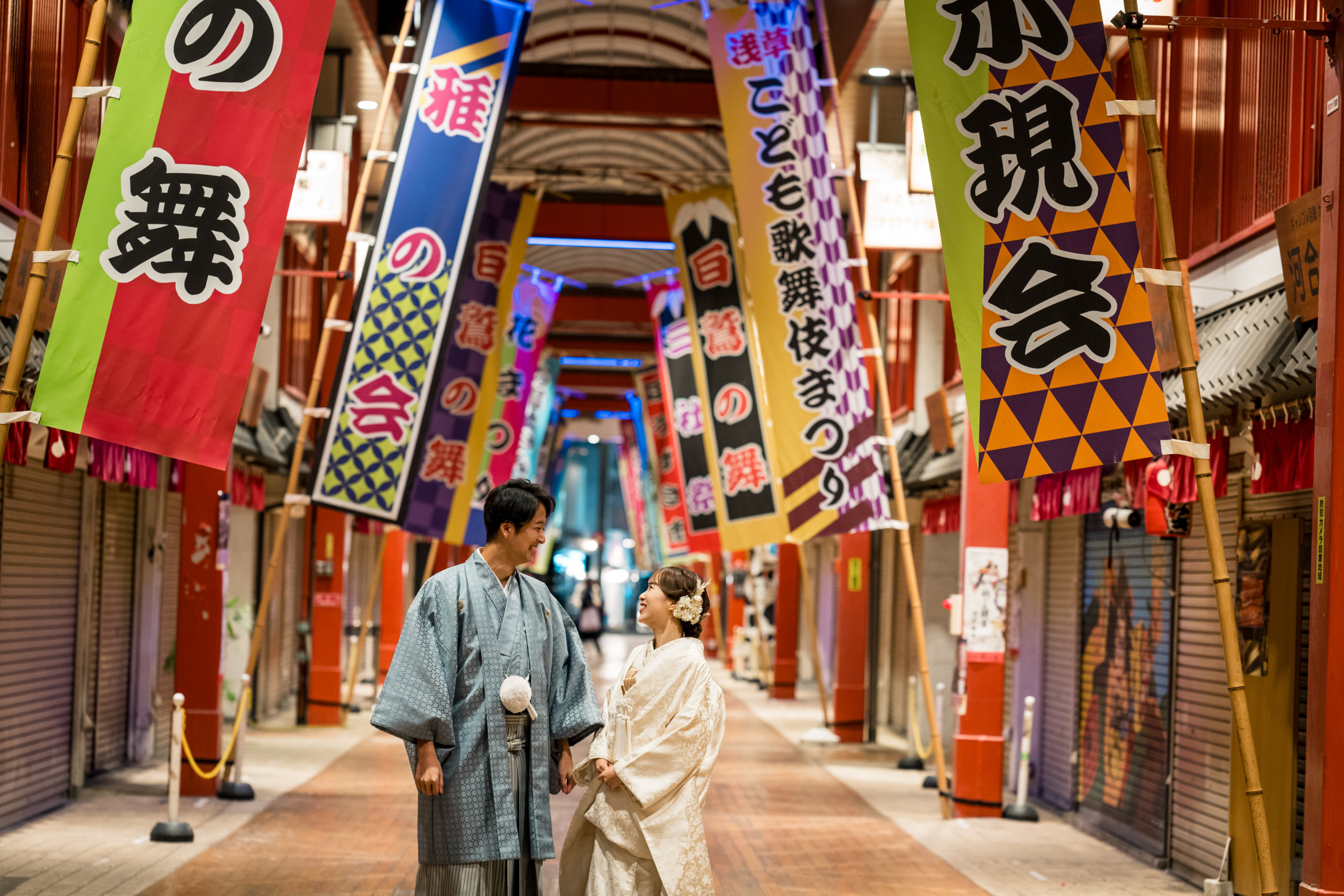
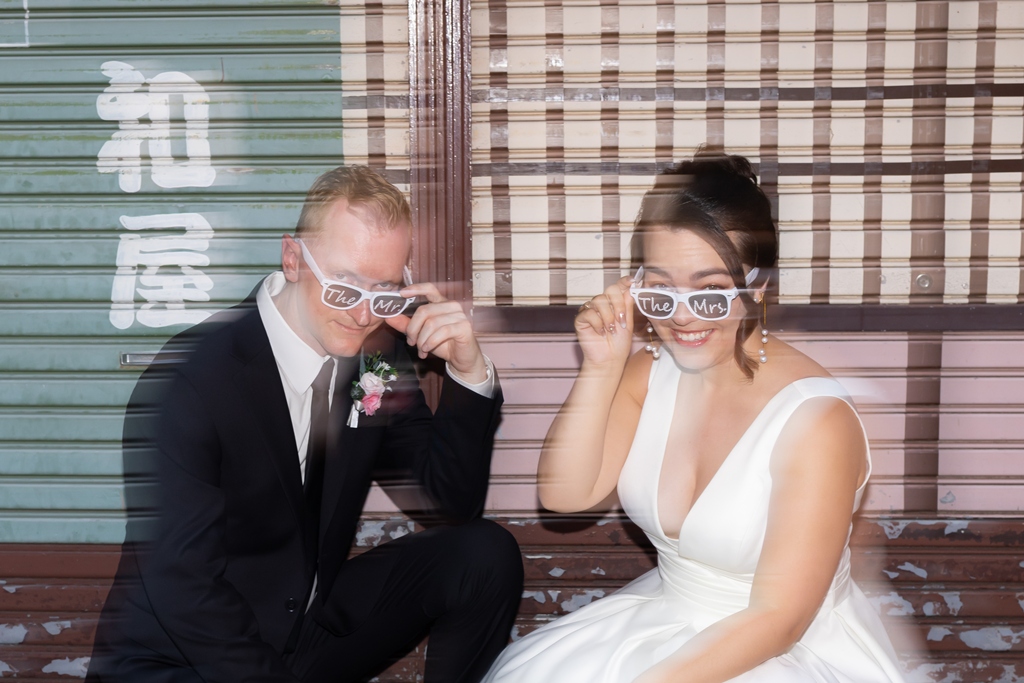
WEDDING AVENUE TOKYO STATION STUDIO
Ancient Tokyo. Modern Tokyo.
Both in one extraordinary day.
Questions about Asakusa and Skytree shoots, kimono selection,
seasonal timing, or planning your Tokyo visit?
Free consultations available every day — in English.
📍 1-2-8 Hacchobori, Chuo-ku, Tokyo / 10 min walk from Tokyo Station Yaesu Exit